
Menu Close

Smoke Detector Inspections

Smoke & Carbon Monoxide Detector Inspections

For homeowners, the Fire Prevention Division plays a vital role during the transfer of real estate. We conduct mandatory inspections for home sales to verify compliance before closing, ensuring new owners move into a safe environment.

How to Schedule an Inspection

We operate on a daily scheduling system to maximize efficiency.

  • Call Us: Please dial (781) 293-9571 on the morning of the day you would like your inspection performed.
  • Availability: We do not pre-schedule smoke detector inspections.
  • Please note: Inspections are performed based on daily manpower and emergency call volume. While we strive to accommodate all requests, inspections are not guaranteed on the day you call.
  • The Fee for Smoke Detector inspections is $50. This is payable by Check or Money order, payable to “Town of Hanson”. We now offer the ability to pay by card; a $2 fee applies.
Hanson Fire Trucks

What determines my requirements?

The year the home was built. If a building was built or has undergone major renovation, addition, or modification after Jan. 1, 1975, the date the building permit was issued determines the smoke alarm requirements.

Am I required to have smoke alarms or CO alarms?

All homes are required to have smoke alarms.
Since March 31, 2006, carbon monoxide alarms have been required in all residences.

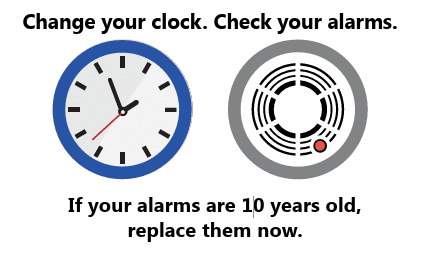
How Do I Know if my Smoke Alarm is More than 10 Years Old?

The manufacturer’s date is located on the back of the smoke alarm. Carefully remove the alarm from its mounting bracket to check the date.
If there is no date marked, then the alarm is more than 10 years old. If the date indicates it was manufactured more than 10 years ago, replace it with a new alarm.

Can I Use New Wireless Technology?

Yes, you can use new wireless technology.
• In homes built before 1975, alarms can be wirelessly interconnected and now must have a 10-year sealed battery.
• In homes built or modified after 1975, they may be wirelessly interconnected, but cannot be wirelessly powered; they must be hard-wired per the State Building Code.

Smoke Detector Requirements

Requirements for buildings to pass inspection

Make sure that your posted street number is visible from the street (MGL c.148 § 59) on your home and mailbox

Use the drop-downs below to determine your alarm requirements. You will use the year the home was built, or the permit date of the last major renovation, addition, or modification.

*It is the requestor’s responsibility to determine the year the home was built or permit issue date from the building department if needed.

I have a retreat lot; is anything extra required?

The Town of Hanson has the following bylaws.

Show more

Built Before January 1, 1975

Smoke alarms are required as follows:

  • On every habitable level of the residence.
  • In the basement.
  • On the ceiling at the base of each stairway leading to a floor above, including the basement (but not within stairways).
  • On the ceiling outside each separate sleeping area.
  • Must be photoelectric. (Can be in combination with ionization or carbon monoxide.)
  • May be battery-powered, hardwired, or a combination of both.
  • Smoke alarms cannot be more than 10 years old or exceed the manufacturer’s recommended life, whichever comes first.
  • In two-family dwellings, smoke alarms are required in common areas shared by residents.

New or Replacement alarms:

  • Must be photoelectric. (Can be in combination with ionization or carbon monoxide.)
  • Must contain a hush feature to silence nuisance alarms.
  • Battery-powered alarms must have 10-year, sealed, nonrechargeable, non-replaceable batteries.

Carbon monoxide alarms are required as follows:

  • On every level of the residence, including habitable portions of basements and attics, and must be located within 10 feet of each bedroom door.
  • Combination alarms (photoelectric smoke and carbon monoxide alarm) may be used.
  • Combination alarms must have both a tone and simulated voice alarm to distinguish the type of emergency.
  • May be either: battery-powered, plug-in with battery backup, hardwired with battery backup, or system type.
  • Follow the manufacturer’s instructions for placement.

Built or Addition/Major Renovation Between
January 1, 1975 and August 27, 1997

Smoke alarms are required as follows:

  • On every habitable level of the residence.
  • In the basement.
  • On the ceiling at the base of each stairway.
  • On the ceiling outside each separate sleeping area.
  • Must be photoelectric.
  • A minimum of one smoke alarm must be installed for every 1,200 square feet of living space per level.
  • Must be hardwired interconnected smoke alarms
  • Smoke alarms cannot be more than 10 years old or exceed the manufacturer’s recommended life, whichever comes first.

Carbon monoxide alarms are required as follows:

  • On every level of the residence, including habitable portions of basements and attics, and must be located within 10 feet of each bedroom door.
  • Combination alarms (photoelectric smoke and carbon monoxide alarm) may be used.
  • Combination alarms must have both a tone and simulated voice alarm to distinguish the type of emergency.
  • May be either: battery-powered, plug-in with battery backup, hardwired with battery backup, or system type.
  • Follow the manufacturer’s instructions for placement.

Detectors must be hardwired interconnected.

All Smoke alarms MUST be photoelectric.

Built or Addition/Major Renovation Between
August 28, 1997 and December 31, 2007

Smoke alarms are required as follows:

  • On every habitable level of the residence.
  • In the basement.
  • On the ceiling at the base of each stairway.
  • On the ceiling outside each separate sleeping area.
  • On the ceiling inside every bedroom.
  • Must be photoelectric.
  • A minimum of one smoke alarm must be installed for every 1,200 square feet of living space per level.
  • Must be hardwired interconnected smoke alarms with battery backup.
  • Smoke alarms cannot be more than 10 years old or exceed the manufacturer’s recommended life, whichever comes first.

Carbon monoxide alarms are required as follows:

  • On every level of the residence, including habitable portions of basements and attics, and must be located within 10 feet of each bedroom door.
  • Combination alarms (photoelectric smoke and carbon monoxide alarm) may be used.
  • Combination alarms must have both a tone and simulated voice alarm to distinguish the type of emergency.
  • May be either: battery-powered, plug-in with battery backup, hardwired with battery backup, or system type.
  • Follow the manufacturer’s instructions for placement.

Built or Addition/Major Renovation Between
January 1, 2008 and February 3, 2011

Smoke alarms are required as follows:

  • On every habitable level of the residence.
  • In the basement.
  • On the ceiling at the base of each stairway.
  • On the ceiling outside each separate sleeping area.
  • On the ceiling inside every bedroom.
  • Must be photoelectric.
  • A minimum of one smoke alarm must be installed for every 1,200 square feet of living space per level.
  • Must be hardwired interconnected smoke alarms with battery backup.
  • Smoke alarms cannot be more than 10 years old or exceed the manufacturer’s recommended life, whichever comes first.

Carbon monoxide alarms are required as follows:

  • On every level of the residence, including habitable portions of basements and attics, and must be located within 10 feet of each bedroom door.
  • Combination alarms (photoelectric smoke and carbon monoxide alarm) may be used.
  • Combination alarms must have both a tone and simulated voice alarm to distinguish the type of emergency.
  • Must be hardwired and interconnected with battery backup. (May be separately wired from the existing smoke detector system)
  • Follow the manufacturer’s instructions for placement.

Heat alarms are required as follows:

  • Must have a single heat alarm in any garage attached to or under the residence.
  • Must be hardwired and interconnected with or without battery backup to the existing smoke detection system.

Smoke alarms must be photoelectric.

Heat Detectors become required in attached garages after January 1, 2008
Built or Addition/Major Renovation On or After
February 4, 2011

Smoke alarms are required as follows:

  • On every habitable level of the residence.
  • In the basement.
  • On the ceiling at the base of each stairway.
  • On the ceiling outside each separate sleeping area.
  • On the ceiling inside every bedroom.
  • Must be photoelectric.
  • A minimum of one smoke alarm must be installed for every 1,200 square feet of living space per level.
  • Must be hardwired interconnected smoke alarms with battery backup.
  • Smoke alarms cannot be more than 10 years old or exceed the manufacturer’s recommended life, whichever comes first.

Carbon monoxide alarms are required as follows:

  • On every level of the residence, including habitable portions of basements and attics, and must be located within 10 feet of each bedroom door.
  • Combination alarms (photoelectric smoke and carbon monoxide alarm) may be used.
  • Combination alarms must have both a tone and simulated voice alarm to distinguish the type of emergency.
  • Must be hardwired and interconnected with battery backup. (May be separately wired from the existing smoke detector system)
  • Follow the manufacturer’s instructions for placement.

Heat alarms are required as follows:

  • Must have a single heat alarm in any garage attached to or under the residence.
  • Must be hardwired and interconnected with or without battery backup to the existing smoke detection system.

Smoke alarms must be photoelectric.

Heat Detectors become required in attached garages after January 1, 2008

Massachusetts Smoke and CO Detector Guide